Sachidanand Sinha
"Thought-trip" of socialist thinker Sachidanand Sinha, by Shubhneet Kaushik
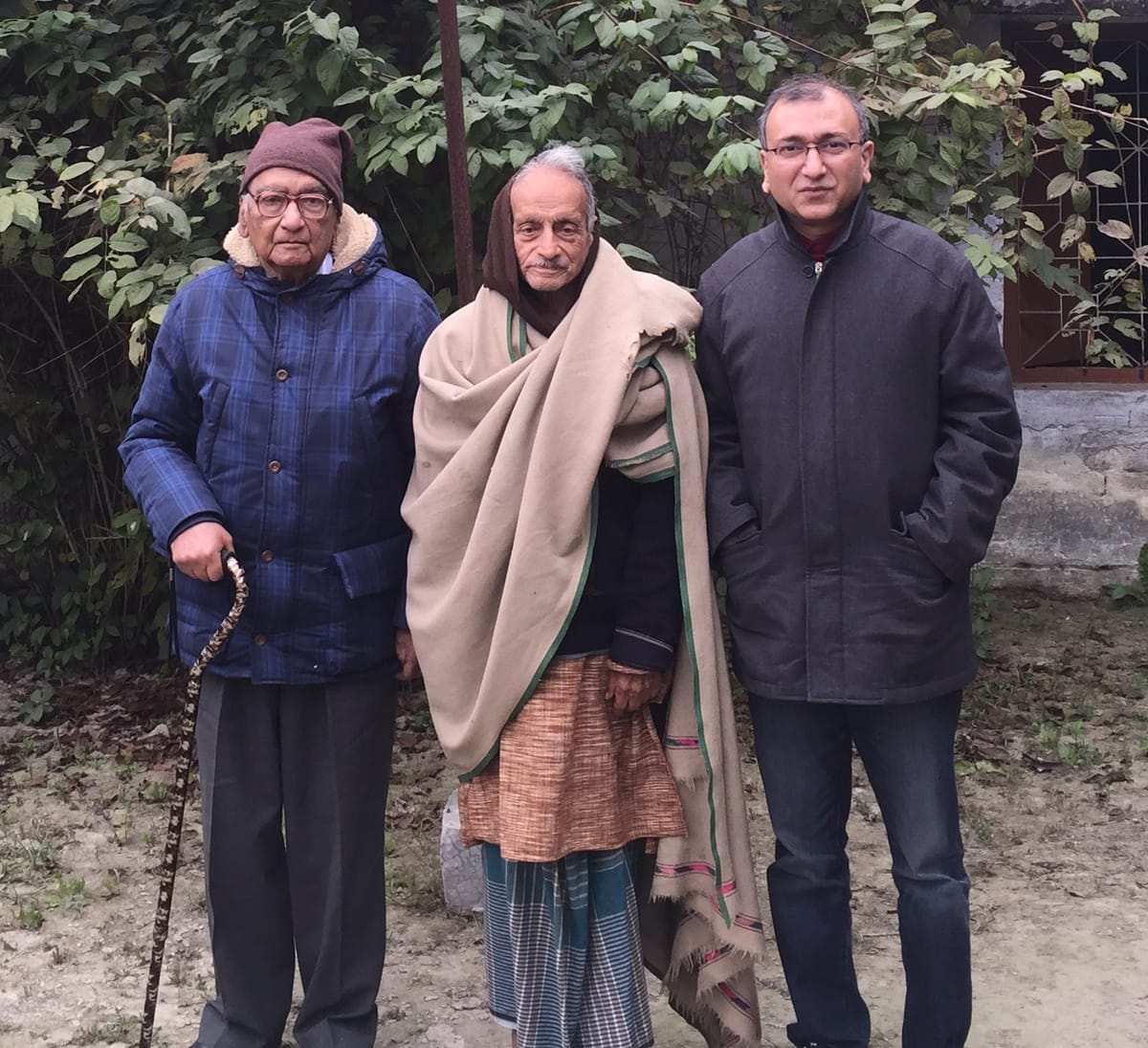
The publication of Sachchidanand Sinha Rachanavali should be welcomed as an important event for the Hindi literary world. And for an ordinary reader, journalist, and writer like me, having the opportunity to play a major role in this undertaking is both a matter of immense pride and great responsibility. There is perhaps hardly anyone today more learned than Sachchida Ji—at least in the field of social sciences. Whether it is political science, economics, history, sociology, anthropology, philosophy, art, culture, human psychology, aesthetics, or religion, his depth of study in all these areas is astonishing.
But he is not merely a scholar who reads and reproduces ideas. He is a thinker who continuously reflects on the many dimensions of life, drawing from his vast study and his experiences in social and political activism. He constantly seeks solutions to the contradictions that emerge between theory and lived experience. On this basis, he has produced an enormous body of serious writing. What is even more remarkable is that he accomplished all this without being attached to any academic institution or receiving any research fellowship. Sachchida Ji devoted his long life to study and socio-political work, and his high-level writing alone spans more than fifty years.
Yet Sachchidanand Sinha is not simply a writer or a comfortable intellectual living a life of contemplation. At a very young age, inspired by the socialist movement—especially by Jayaprakash Narayan—he decided not only to become a full-time political worker and leave home, but also to engage in hard physical labor such as breaking coal and stones and carrying loads, both to experience manual work and to support himself. During this period, through his association with socialist labor organizations and the study camps organized by them, he pursued extensive self-education. He also acknowledges the contribution of borrowing books from rival labor unions’ libraries and engaging in ideological debates with them.
In one such debate, a newspaper comment he had written caught the attention of socialist leader Rammanohar Lohia. Lohia sought him out and directly brought him onto the editorial board of his journal Mankind. Following this, Sachchida Ji moved from Mumbai to Hyderabad, and later to Delhi, where he continued political work with the Socialist Party, the Samata organization, and the Samajwadi Jan Parishad, while focusing primarily on writing. Most of his serious writing belongs to this phase of his life. Earlier, while in Mumbai, he had also served as Dr. Ambedkar’s election in-charge. During the Emergency, he was in charge of George Fernandes’ 1977 Muzaffarpur election campaign while Fernandes was imprisoned in the Baroda Dynamite Case. Sachchida Ji never hesitated to undertake even the smallest political task, and during the Emergency, while living underground in Delhi, he carried out as much political work as possible.
After spending nearly fifteen years in Delhi, he realized that keeping up with the increasing cost of living would require compromises he did not want to make. So he returned directly to his village, Manika (Muzaffarpur). The village attracted him not only intellectually but also practically. Very few people, in my experience, leave cities like Delhi or Mumbai to return permanently to village life. Sachchida Ji came from a very prosperous family background, yet apart from a small living space, he cared little for material possessions. In practice, he lives almost like a sage, using minimal resources in a Gandhian manner. This reflects both restraint in the use of worldly resources and a disciplined effort to control one’s desires and mind.
He never married, partly because of his political commitments and other reasons during the age when people usually marry. Yet family remains deeply important to him. Through his lifestyle and personal choices, he presents an ideal, though he never imposes it on others. In fact, he genuinely tries to live according to what he writes and says. This explains why environmental concerns and pollution occupy such an important place in his later writings. While Gandhi and Lohia also emphasized these issues, most socialist thinkers—including Marxists—have generally neglected questions of consumption and environment. Interestingly, despite being deeply influenced by Jayaprakash Narayan and Rosa Luxemburg, Sachchida Ji remained Marxist in orientation from the beginning.
What is astonishing is that despite writing on such a wide range of subjects, the quality of his arguments and writing never weakens. On the contrary, the more one reads him, the more one is amazed by the breadth of his thought and understanding. Most of his early writings were in English, and translations of those works are included here. Many had already been translated and published earlier, though some essential material was translated specifically for this collected edition. Among his early books, only Samajwad ke Badhte Charan was written specifically for Socialist Party workers. At the request of his dear friend Giridhar Rathi, he wrote in Hindi his book Zindagi Sabhyata ke Hashiye Par, dealing with urbanization and the marginalized lives of those surviving on the edges of city civilization, though it took a long time to get published.
However, after the publication of Sanskriti Vimarsh, the Hindi world embraced his writings enthusiastically. Later, when he wrote the fourth volume of Marx’s Capital, he wrote it directly in Hindi as well. Only one booklet was written in English. Besides Hindi and English, he also knows several foreign languages such as French and German—from conversational ability to reading proficiency. Although he never formally studied Sanskrit, he could, with the help of a dictionary, easily understand even difficult Sanskrit-rich works like those of Acharya Narendra Dev, including texts containing Pali and Prakrit.
In the Rachanavali, he appears in several forms. Most significant are his serious academic and philosophical works as a writer and thinker. But he also wrote extensively as a political worker and commentator, intervening intellectually on major issues and advancing his arguments. In one such intervention, he directly reminded his writer-friend Nirmal Verma that “human beings live within ideology.” He also prepared extensive material for Socialist workers, members of the Samata organization and Samajwadi Jan Parishad, and activists from many like-minded groups and training camps—a tradition that is now disappearing from Indian politics. He presented research papers and delivered lectures at many academic forums as well.
Another large part of his writing consists of newspaper articles, a substantial archive of which was provided by our colleague Achyutanand Kishore “Naveen.” Even after selecting much material, a great deal still had to be left out. Yet Sachchida Ji’s journalistic writing was never mere freelancing or a source of income. Every article and commentary rises above routine news analysis, and often one feels he was simply waiting for a particular event as an opportunity to express a larger truth.
Perhaps his greatest contribution through these writings has been his analysis and critique of globalization, along with his attempts to propose alternatives to it. Many people, including the editor of this collected edition, will always regret that despite writing major books on numerous serious subjects, Sachchidanand Sinha never produced one large, definitive work solely on globalization. The main reason for this was probably his retreat to village life, because intellectually he never showed signs of fatigue or despair. What he did write on globalization represents not only his intellectual brilliance but also one of the finest critiques of globalization policy in all political and social thought.
For Sachchidanand Sinha, respect for diversity, opposition to centralization, and sustainable development are not the only foundational values. Equality, freedom, democracy, human rights, respect for all forms of life, nonviolence (though he does not reject certain forms of violence in exceptional situations), truth, and disarmament are equally eternal and fundamental values. Environmental concerns also emerge very strongly in his later writings. Therefore, for him, opposing globalization while proposing alternatives based on these values was not difficult. Even when he writes about art, these values and a specifically Indian perspective remain visible. He also critiques urbanization—whose harmful effects he discusses in one of his books—as part of the broader process of centralization. Similarly, his criticism of Soviet and Chinese communist systems arises from his concern over the violation of these same values.
When he writes about popular struggles for freedom in history, he naturally sides with oppressed and weaker groups. Even during Rajiv Gandhi’s era, when Congress ruled with 413 MPs, he boldly argued in favor of coalition politics, seeing it as more suitable for India because it allowed representation of diverse regions, castes, and linguistic groups. Throughout his writings on Indian politics, he consistently uses these values and analytical tools.
His book on Gandhi, however, is of a completely different nature and required a different kind of study. Whenever he wrote a book, he worked with the same dedication and labor that a farmer devotes to his field or an artisan to his craft. Fortunately, I too had the opportunity to witness this labor-intensive style of study while staying with him during the writing of his Gandhi book. Perhaps even more intense study went into his books on socialism, power, and art. Physical effort went into every book, but the intellectual labor was equally immense. Often one feels these books were written out of a restless desire to explain difficult ideas with absolute clarity, since there was rarely any commercial motive behind his writing. Anyone who has seen him explaining things to young political workers will recognize the same tone in his serious books—carefully building arguments through examples and patiently ensuring that every idea is fully understood.
At the same time, one also finds a beautiful blend of scholarly knowledge with folk wisdom, insights drawn from ordinary people, and personal experience. For his book on caste, he traveled extensively and held long conversations with knowledgeable individuals. As a result, he made several truly original observations about the caste system. Sociologists have written extensively on caste, but his book presents an entirely distinct perspective. Needless to say, this work too was not part of any academic project, nor did he receive any grant for it. That someone could accomplish so much driven purely by intellectual restlessness and conviction is astonishing.
Sachchida Ji maintained direct dialogue not only with contemporary politicians but also with writers, artists, intellectuals, and thinkers. Though he did not pursue formal higher education very far, he acquired not only bookish knowledge but also practical experience, refusing to limit himself merely to manual labor or trade union work. His ability to master Hindi, English, French, and German to the point of reading and speaking them is itself remarkable. He also had intellectual exchanges with figures like Schumacher and Lothar Lutze. During his literary and intellectual journey, he developed long associations with many writers and journalists. Yet when Nirmal Verma, who once dedicated books to him and held long discussions with him, drifted toward supporting the temple movement and the “end of ideology” thesis, Sachchida Ji openly criticized him in writing.
He also had deep connections with artists such as Ram Kumar, Krishen Khanna, Jagdish Swaminathan, and Himmat Shah. In fact, at Krishen Khanna’s request, he wrote the art appreciation book Aroop aur Akaar for the Lalit Kala Akademi. Even today, the book surprises many people, especially because it seems extraordinary that someone deeply immersed in socialist and trade union politics throughout his life could produce such a work.
Sachchida Ji did not limit himself to “non-socialist” or non-political subjects like art and culture. He also wrote extensively on urban poverty, Bihar’s economic backwardness, the inevitability of internal colonialism within the prevailing development model, the caste system (which the author of these lines considers his most important book), the crisis of agriculture under this development model, Marxism, coalition politics, global struggles for freedom in history, and Indian politics. In this sense, apart from Gandhi, he has written more extensively than perhaps anyone else associated with the socialist tradition in India. Through his writings, one can find a clear Gandhian-Lohiaite perspective on caste, religion, art, culture, development, environment, and many other issues.
Even where he diverges from Gandhi and Lohia, his conclusions often seem more convincing because they emerge from deep study and sustained reflection. Gandhi and Lohia sometimes spoke on the basis of broad intuitions or assumptions, whereas Sachchida Ji’s writings on caste, culture, and art take the Gandhian-Lohiaite intellectual tradition much further. For this reason too, the publication of his collected works is an important event.
This Rachanavali will not only accomplish many important tasks but also correct a long-standing omission, because anyone who has read even one of Sachchida Ji’s important works inevitably begins searching for the others.
Do read this article by Arvind Mohan about this creation and Sachida ji published by Rajkamal Publications:
https://samtamarg.in/.../29/sachchida-ji-and-her-creations/